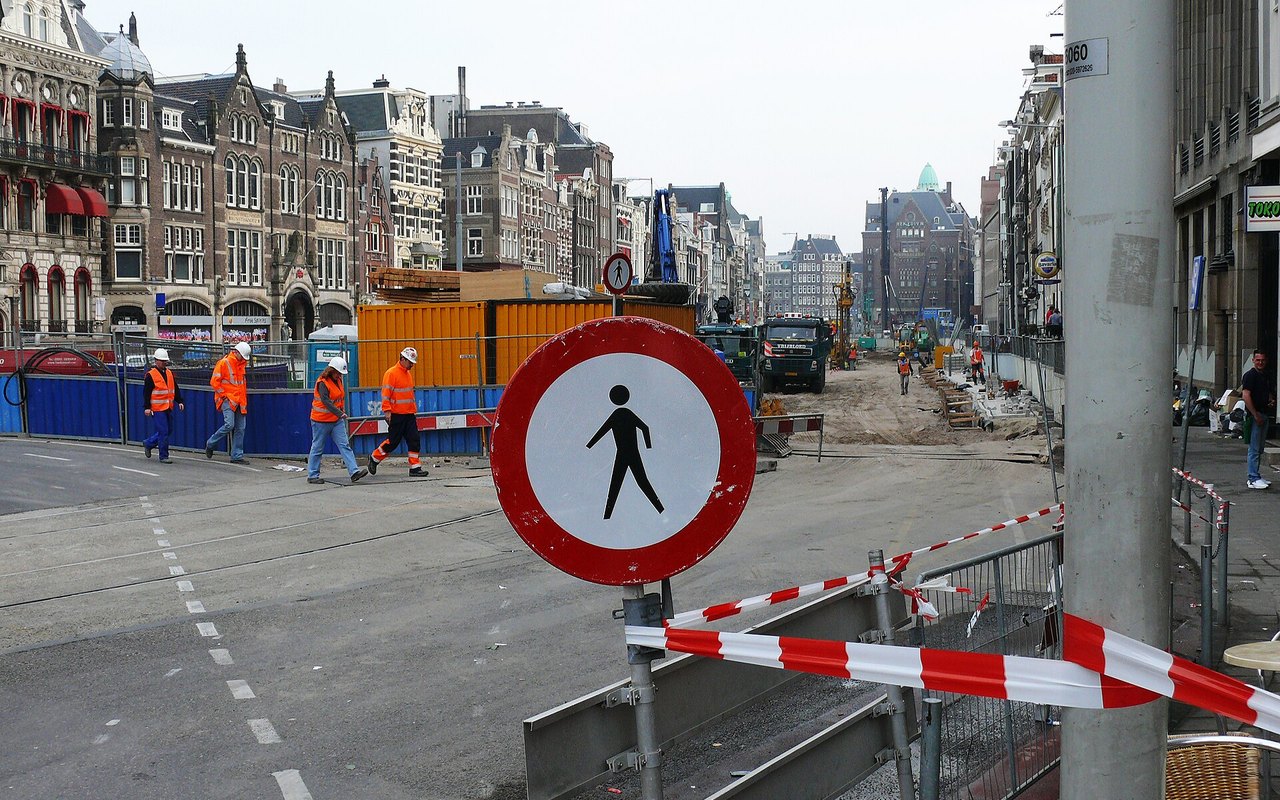
Construction and infrastructure workers raise the skylines, highways, bridges, hospitals, and power lines that hold the country together. The field offers hands-on careers across residential, commercial, and infrastructure projects, with many pathways that do not require a four-year degree.

Construction and infrastructure is the industry that takes a plan — "we need a school here", "this highway needs another lane", "connect these towns to clean water" — and turns it into something real you can stand on, drive over, and live inside.
It exists because everything around you had to be designed, dug, poured, framed, wired, and finished by someone. The road to your school, the stadium you cheer in, the hospital that treats you, the tower downtown — a construction crew built every one of them.
It's a field for people who like working with their hands, seeing real progress every day, and being able to point at a finished building and say "I helped build that." Many careers can be entered through paid training or education pathways that may cost less than a four-year degree.
It's not just the paycheck (though the paycheck is real). Here's what makes construction one of the smartest career bets you can make at 14, 18, or 22 — often without a mountain of debt.
You do not need a four-year university to build a great construction career — most people don't. Here are the real pathways American students take — start with what you study in high school.
No matter which route you take, these are the subjects that open every construction door. Take the hands-on and technical classes seriously — and grab any CTE, shop, or dual-enrollment options your school offers.
"Construction" isn't one job — it's a whole family of trades and roles. Tap any discipline to see what they build, where they work, what they earn, and how strong demand is.
Illustrative U.S. salary ranges by career. Actual pay varies by occupation, experience, location, union coverage, overtime, and employer. The verified field-wide median was $59,540 in May 2025.
You don't need straight A's in everything — you need the right foundation and some hands-on practice. Load up on these and you'll be ready for any construction path.
Trade knowledge gets you on the crew. These skills are what get you hired, promoted, and paid more — and you can start building them right now.
Job sites throw surprises daily. Figuring out a fix on the spot is what makes you valuable to any crew.
The #1 skill on any site. Working safely protects you, your crew, and your future in the trade.
Construction is active work. Being fit, steady, and able to put in a full day sets you apart.
Explaining a problem, reading a plan aloud, and coordinating with other trades keeps the job moving.
Nothing gets built alone. Electricians, carpenters, and operators all depend on each other every day.
Showing up on time, every day, ready to work is the fastest way to earn trust — and a raise.
Drones, GPS layout, BIM, and project apps. The workers who learn new tools fastest move up fastest.
Measure twice, cut once. A small mistake in construction can cost thousands — precision matters.
Turning 2D plans into a real building in your head is a skill every top tradesperson has mastered.
Examples of major companies working across construction, engineering, infrastructure, homebuilding, and equipment. Hiring needs and available roles change over time.
New tools, materials, and infrastructure investment are changing how projects are planned and built. Scroll across to explore major trends →
It can be a strong choice for people who enjoy practical problem-solving and seeing tangible results. The field-wide median was $59,540 in May 2025, and BLS projects faster-than-average employment growth for construction and extraction occupations overall. Pay, demand, working conditions, and entry requirements vary by occupation and location.
Many construction trades do not require a bachelor's degree; workers may learn through an apprenticeship or on-the-job training. Licensing and certification requirements vary by occupation and state. Construction management and engineering roles more commonly require a degree, although some managers qualify through extensive construction experience.
Pay varies widely. BLS reported a May 2025 median of $114,990 for construction managers and $109,910 for elevator and escalator installers and repairers. Electricians had a $63,190 median, plumbers and pipefitters $63,800, and carpenters $60,580. Location, overtime, experience, and union coverage can materially change earnings.
A registered apprenticeship combines paid work, structured on-the-job learning, related classroom instruction, progressive wage increases, and a nationally recognized credential. Program length, entry requirements, fees, and sponsorship vary by trade and location.
Construction includes serious hazards, so employers must provide required training and protections, and workers must follow site procedures and use appropriate protective equipment. Risk differs by role and worksite; office-based planning and design roles generally have different exposure from field trades.
Prioritize math — especially geometry and algebra — because you'll use it constantly for measuring, layout, and estimating. Add physics for understanding loads and forces, and take any shop, drafting/CAD, or CTE construction classes your school offers. A business or economics class helps if you dream of owning a company. And don't skip English — managers write and read contracts all day. Hands-on projects and safety certs are a big bonus.
Automation is more likely to change tasks than eliminate the entire field. Drones, robotics, 3D printing, and building information modeling can improve surveying, monitoring, fabrication, and coordination, while many site tasks still require judgment and adaptation. Learning digital tools alongside core trade skills can broaden your options.
Construction connects to nearly everything. If it interests you, these industries are worth a look too — many share the same skills and employers.